
How Meesho Became Profitable Selling Low-Cost Products: Welcome to our website. We all know that Meesho has reached almost every household today. Meesho’s contribution to people in Tier-2 and Tier-3 cities is truly unparalleled. It has transformed the way people shop online by making products affordable, accessible, and trustworthy. So, in this article, I will tell you how Meesho became profitable, the strategies they used, and how they successfully captured the market in smaller cities. You will also learn about the innovative business model, logistics solutions, and marketing tactics that helped Meesho grow rapidly.
How Meesho Became Profitable Selling Low-Cost Products
Meesho is one of India’s fastest-growing social commerce platforms, transforming the way people shop online, particularly in Tier-2 and Tier-3 cities. The founders, Vidit Aatrey and Sanjeev Barnwal, initially launched their first venture, Fashnear, meaning “fashion near me.” Their goal was to help local retailers sell products through a dedicated platform, similar to how Zomato and Swiggy operate for food delivery.
They personally visited shops in Bangalore, listed products online, and even delivered items themselves to gather direct customer feedback. However, this model did not succeed, and after a year, they realized the business needed a new direction.
In 2015, they rebranded as Meesho, meaning “my showroom.” At that time, the founders noticed that sellers were already selling products through WhatsApp or social media. They implemented a referral system where anyone could register as a reseller.
A reseller system works like this:
- Example: Ramesh is a manufacturer who makes a t-shirt. He gives the product to Meesho. If someone likes the product, they can generate a link and share it with friends. The product price is ₹150, but if sold for ₹300, the reseller earns ₹150.
- Meesho manages delivery, returns, and cash on delivery, making it easy for resellers.
This approach quickly became popular in Tier-2 and Tier-3 cities, where e-commerce adoption was low and people were hesitant to buy products online. Customers trusted purchases shared by friends or family, which helped Meesho capture these markets.
Funding, Challenges, and Growth (2016–2021)
In 2016, Meesho received funding from Y Combinator, and Facebook invested in the company. Despite this support, the business was not profitable. Customers were using the platform, but the company faced financial losses.
In 2019, Meesho expanded into electronics and home appliances, expecting growth in Tier-2 and Tier-3 cities. However, COVID-19 impacted the business:
- Resellers could not buy or sell products
- Buyers reduced spending due to income loss
- Fashion demand declined
Even so, organic traffic continued, as customers trusted Meesho from previous purchases.
In 2021:
- Raised $300 million in Series E
- Raised $570 million in Series F
- Valuation reached $4.9 billion
With this funding, Meesho tried FMCG products and experimented with social and live commerce. However, FMCG has low profit margins and high competition, so Meesho exited FMCG to focus on its core marketplace model.
Meesho Marketplace Model: How It Works and Makes Profit
Meesho later introduced a marketplace model. In a traditional marketplace, sellers list their products on a platform, and the platform charges a commission on each sale. But Meesho’s approach is different—they do not charge any commission.
Their idea is simple: customers visit the Meesho website or app, select products, and get them delivered to their homes. Meesho manages the delivery process through third-party logistics partners, ensuring smooth and reliable delivery.
For example, if the actual delivery cost is ₹80, Meesho charges the seller ₹100, earning a ₹20 profit per order. This method allows Meesho to generate revenue without taking a commission from sellers.
Capturing Tier-2 and Tier-3 Cities
Meesho’s marketplace model helped them capture Tier-2 and Tier-3 cities in India:
- They sell almost all products under ₹500, attracting budget-conscious buyers.
- The average order value is around ₹400.
- They understand local challenges like slow internet speeds, so the app has a simple and user-friendly UI for 2G and 3G networks.
- To build trust, Meesho provides cash-on-delivery and return facilities, making online shopping safer for first-time buyers.
Turning Point: Ad Revenue and Delivery Optimization
Despite initial traction, Meesho’s business was not profitable. They faced losses and funding issues from investors. To survive, they cut costs drastically, which resulted in job reductions, but organic traffic continued to grow.
Meesho then changed its business model, which became the turning point for profitability:
1. Ad Revenue Generation:
- Previously, Meesho earned only through delivery commissions.
- Later, they introduced ads: sellers could pay to list their products at the top of search results.
- This helped sellers get more visibility and allowed Meesho to earn additional revenue.
- By August 2022, Meesho generated ₹100 million in ad revenue.
2. Delivery Cost Optimization:
- Earlier, Meesho charged ₹80 for delivery, which discouraged buyers in Tier-2 and Tier-3 cities, especially for low-value orders (e.g., ₹269).
- In 2024, delivery charges were briefly ₹84, leading to significant losses.
- By reducing delivery charges to ₹37, Meesho reduced losses by 93%.
These two strategies—ad revenue and optimized delivery costs—were the major factors that turned Meesho’s business profitable.
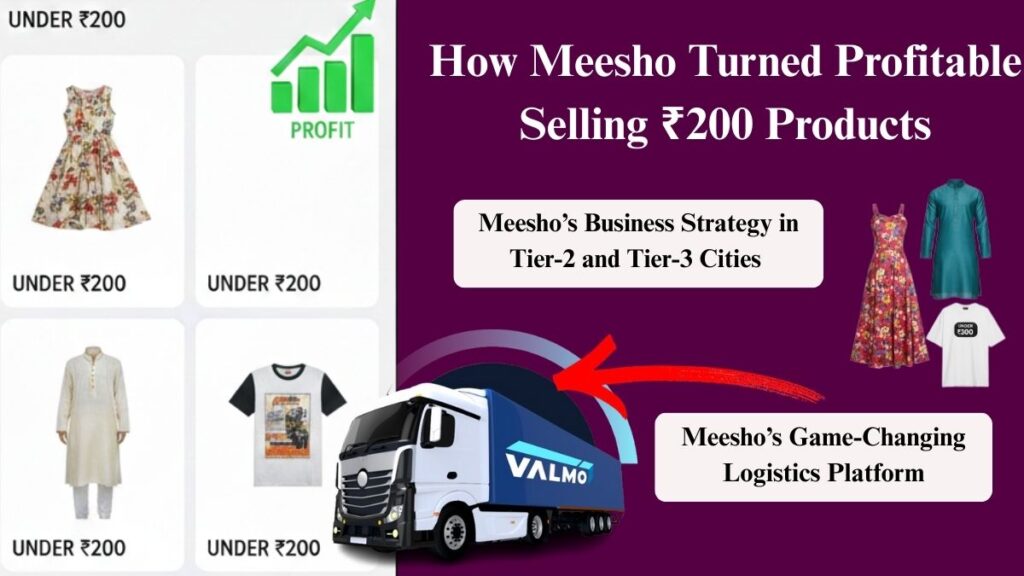
Valmo: Meesho’s Game-Changing Logistics Platform
In 2024, Meesho took one of its best decisions by launching its own logistics arm, Valmo. This move played a crucial role in improving Meesho’s delivery efficiency and reducing logistics costs.
Valmo is not a traditional logistics company. It owns 0 cars and 0 warehouses. Instead, Valmo works like an Uber-style logistics platform. It does not own any logistics assets. Valmo acts as a software layer that connects thousands of logistics partners into one massive delivery network. It is not a platform that provides end-to-end delivery services.
Meesho created a system where all courier partner services are listed on one platform. Valmo’s platform decides which courier partner should handle each delivery. It checks whether the order should go to existing partners or to another courier that can deliver at a better cost and higher efficiency.
In the beginning of 2022, almost 35% of third-party logistics shipments in India came from Meesho, showing the scale of its operations.
Earlier, where companies like Amazon and Flipkart were able to create margins, Meesho was not able to do so. After introducing Valmo, Meesho achieved a 5–7% reduction in logistics costs, and its profit margin increased by 5–7%.
Conclusion
Meesho’s journey shows how a business can become profitable by understanding Tier-2 and Tier-3 city customers. By selling low-cost products, not charging commission from sellers, and focusing on trust, simple UI, and cash on delivery, Meesho built a strong customer base.
When losses increased, Meesho reduced costs, introduced ad revenue, and solved the biggest problem—delivery cost. The launch of Valmo, an asset-light logistics platform, helped reduce delivery expenses and improve margins.
By optimizing ads, logistics, and delivery pricing, Meesho successfully reduced losses and turned its low-value product model into a profitable business.
Learn more about Meesho and its marketplace model And How Meesho Became Profitable Selling Low-Cost Products Click here
Click here to know how ITC became one of India’s largest companies
Disclaimer : The information provided in this article is for educational and informational purposes only. The content is based on publicly available data and general knowledge about Meesho. While we strive to provide accurate and up-to-date information, we do not guarantee the completeness, reliability, or accuracy of the content.
This article is not intended to provide financial, investment, legal, or professional advice. Readers are advised to verify information independently and consult a qualified professional before making any business or investment decisions.
We are not affiliated with Meesho or any of its subsidiaries. The use of company names, brands, or trademarks is solely for informational purposes.