
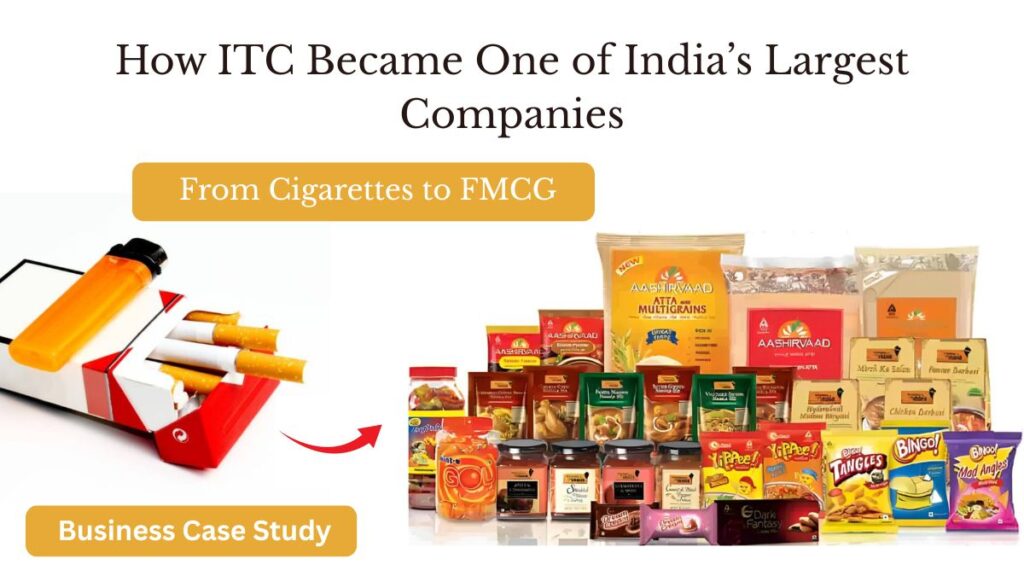
How ITC Became One of India’s Largest Companies: ITC is a household name in India. It has more than 100 years of history and has built a very strong brand across the country. ITC products are everywhere in our daily life — from agarbatti to cigarettes, from biscuits to atta, from notebooks to hotels.Today, ITC is one of the largest and most diversified companies in India. This case study explains how ITC became so big, its business journey, and its success strategy.
How ITC Became One of India’s Largest Companies (History of ITC company)
ITC was incorporated on 24 August 1910 under the name Imperial Tobacco Company of India Limited. Over the years, the ownership of the company gradually shifted from British shareholders to Indian ownership.
In 1970, the company was renamed India Tobacco Company Limited, and later in 1974, it became ITC Limited. As the company expanded into multiple businesses beyond tobacco, the word “Tobacco” was removed in 2001. Since then, ITC is no longer an acronym, but a standalone brand name.
The company’s registered office at Radha Bazar Lane, Kolkata, became the center of its operations. On its 16th anniversary in 1926, ITC purchased land for its headquarters, Virginia House on Chowringhee Road, for ₹3,10,000. This marked the beginning of a long and eventful journey into India’s future.
ITC Across Economic Sectors
The Indian economy is divided into three sectors:
- Primary Sector (Agriculture)
- Secondary Sector (Manufacturing)
- Tertiary Sector (Services)
ITC has a strong presence in all three sectors.
Primary Sector – Agriculture
Agriculture has always been central to ITC’s business. Initially, the company needed to source tobacco directly from farmers, which led to the creation of the ITC Leaf Tobacco Division (ILTD)—a business that is nearly 100 years old.
ITC is the largest buyer, processor, and exporter of leaf tobacco in India, purchasing nearly 50% of all cigarette tobacco grown in the country. Over time, ITC expanded its agricultural network beyond tobacco into agri-commodities and rural services.
ITC directly sources wheat, rice, coffee, spices, and other crops from farmers. A portion is used for its own FMCG products, while the remaining quantity is exported across India and to other countries. ITC is the second-largest exporter of agricultural products in India.
To empower farmers, ITC launched the e-Choupal initiative in Madhya Pradesh. Through internet-enabled kiosks in villages, farmers can:
- Access real-time market prices
- Learn best farming practices
- Buy seeds and fertilizers
- Sell produce directly to ITC
This model removes middlemen and increases farmer income. ITC also provides food safety, R&D, and analytics services through divisions like ITC Agri Business and ITC Analytics.
- Access real-time market prices
- Learn best farming practices
- Buy seeds and fertilizers
- Sell produce directly to ITC
This model removes middlemen and increases farmer income. ITC also provides food safety, R&D, and analytics services through divisions like ITC Agri Business and ITC Analytics.
Secondary Sector – Manufacturing (FMCG & Cigarettes)
The FMCG segment is what ITC is widely known for today. It contributes a large portion of the company’s revenue.
Food Products
- Aashirvaad: Market leader in atta, also sells ghee, salt, spices, instant mixes, and ready-to-eat foods
- Sunfeast: Biscuits like Glucose, Dark Fantasy, Mom’s Magic
- Bingo: Snacks competing with Lay’s (ITC is the 2nd largest player)
- Yippee: Instant noodles (2nd largest after Maggi)
- B Natural: Juices
- Fabelle: Luxury chocolates
- Sunbean: Coffee
- Kitchens of India: Authentic Indian foods
- Farmland & Master Chef: Fruits and vegetables
Personal Care & Other FMCG
- Savlon: Hygiene and antibacterial products
- Fiama, Vivel, Superia: Personal care
- Engage: Deodorants (2nd largest in the segment)
- Classmate & Paperkraft: Stationery (Classmate is No.1)
- Mangaldeep: Agarbatti
- Matchboxes and other daily-use products
Despite the wide FMCG portfolio, nearly 84% of ITC’s total profit still comes from cigarettes. ITC is the market leader in cigarettes in India with about 80% market share. Strong farmer networks and supply chain help ITC source high-quality tobacco. ITC also exports cigarettes to several countries.
Tertiary Sector – Services
ITC entered the hotel business in 1975. Today, ITC Hotels is one of India’s premium luxury hotel chains, operating:
- Over 100 hotels
- Across 70+ destinations
- Under brands like ITC Hotels, Welcomhotel, Fortune, and Mementos
ITC Hotels is known for luxury, sustainability, and service excellence.Additionally, ITC provides technology and software services through ITC Infotech.
sustainability Leadership
ITC is a global leader in sustainability:
- Carbon positive for over 15 years
- Water positive for over 18 years
- Solid waste recycling positive for over 13 years
- 41% of energy from renewable sources
Challenges and Market Perception
Despite strong fundamentals, ITC’s stock performance has been slow. The main reason is its high dependence on the tobacco business, which faces:
- Heavy taxation
- Regulatory pressure
- Negative investor sentiment
However, cigarettes remain a cash cow, generating massive profits with very low marketing spend. ITC is actively expanding its FMCG business to reduce dependence on tobacco.
Conclusion
Founded 114 years ago, ITC is among the top 10 companies in India. With:
- 80% cigarette market share
- Presence in 60 lakh retail outlets
- Exports to 90+ countries
- Position as the 2nd largest FMCG company
ITC’s success is driven by diversification, strong supply chains, deep rural reach, and sustainability focus. The company could not have become this big without expanding far beyond tobacco.
Explore more for in-depth understanding: Click Here
How ITC Became One of India’s Largest Companies: SAQ (Short Answer Questions)
6)Who is the biggest shareholder of ITC Limited?
A: British American Tobacco (BAT) is the biggest shareholder of ITC Limited.
Explore more business case studies on this website: Click here
Disclaimer
The information provided in this article is for educational and informational purposes only. The content is based on publicly available data and general knowledge about ITC Limited. While we strive to provide accurate and up-to-date information, we do not guarantee the completeness, reliability, or accuracy of the content.
This article is not intended to provide financial, investment, legal, or professional advice. Readers are advised to verify information independently and consult a qualified professional before making any business or investment decisions.
We are not affiliated with ITC Limited or any of its subsidiaries. The use of company names, brands, or trademarks is only for informational purposes.
Pingback: How Meesho Became Profitable Selling Low-Cost Products